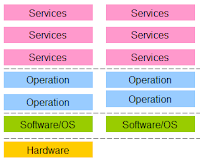
For those who are studying Cloud Computing as an economic system, a more meaningful stratification is probably through its value chain. In particular, I parse them into four (4) categories: Hardware, Software (Operating Systems), Operations, and Services.
Hardware: Admittedly a major allure of Cloud Computing is to render hardware a secondary consideration as commodities. On the other hand, as its fundamental building block, there is no Cloud Computing without hardware. And, given the relative youth of Cloud Computing as an industry, it is hubris to say that hardware is no longer matters. As a matter of a fact, this is one of the competitive advantages if you know what you are doing.
An example of the hardware player is EMC who provides enterprise-class storage solutions.
Software (Operating Systems): I often get asked what is meant by Cloud OS, is it like Windows or Linux? If you think of a Cloud Computing data center as a macro-computer – a warehouse-size computer with a lot of computing, storage, and network/communication capabilities – the ability to orchestrate this macro-computer is indeed an OS (operating system).
An example of the software player is VMWare who provides virtualization software which is a key aspect of multiplexing using Cloud Computing.
Operation: Tedious it may seem, but feeding and caring of the Cloud Computing data centers is as much of an art as it is science. This is an area of tremendous innovation as different operators are competing on different dimensions to meet Cloud consumers's myriad needs.
Amazon is the undisputed operator today. Also worth watching would be Rackspace who has argued that its focus is to provide on-going operator know-how.
Services: this is probably the most visible manifestation of Cloud Computing. From the early success of Salesforce.com to the many Cloud firms that Oracle is snapping up, these are the end-user facing public-face of this eco-systems.
Beyond Salesforce.com, both Netflix and Dropbox are good example of companies that are "pure" Cloud player where they could not exist without the underlying Cloud operator, software, and hardware.


